Part VIII: The Final Test
Reunion and Peace
Books 23–24
The Test of the Bed
Eurycleia goes upstairs to Penelope's chamber. She is nearly laughing with joy. She shakes the sleeping woman awake and tells her: Odysseus is here. He is downstairs. He has killed all the suitors.
Penelope comes down slowly.
She sits across the hearth from the stranger and studies him for a long time without speaking. At one moment she looks him full in the face. Then she looks away. The shabby clothes confuse her. She cannot quite see him.
Telemachus is furious. He tells her she has a heart of stone. No other woman would sit this far from her husband after twenty years.
Penelope answers quietly that if this is truly Odysseus, she and he will know each other. There are things between them that no one else knows.
She turns to the servants and gives an order: bring the bed from the master's chamber, move it outside, and make it up with good blankets.
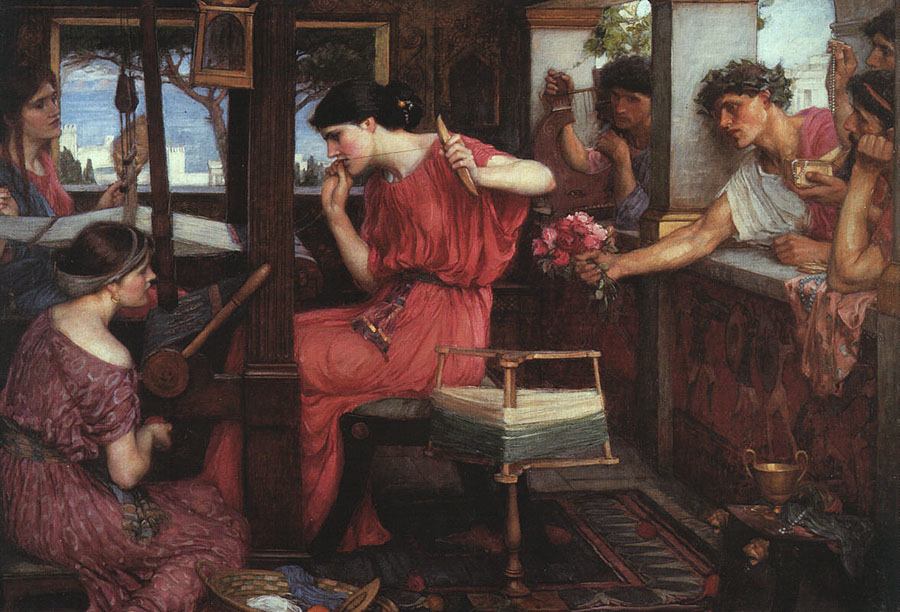
At her words Odysseus was stung with sudden anger. He rounded on her: 'Woman, this is a bitter thing you have said. Who has moved my bed? That would be hard even for a skilled man — though a god could shift it without trouble. No living man, however young and strong, could pry it loose.'
'For here is a great secret in the making of that bed. I built it myself, with my own hands. There was a young olive tree growing inside the court, in full leaf, sturdy as a pillar. I built my bedroom around it, fitting the stone walls, roofing it, hanging the close-jointed doors. Then I lopped the branches from the olive, trimmed the trunk from the root upward, shaped it with bronze tools, trued it to the line, and made it my bedpost. I drilled it and fitted the frame from it, and finished it, inlaying it with gold and silver and ivory.'
'That is what I know of our bed. But has someone cut the tree at the root and moved it? I do not know.'
At those words her knees went weak, and her heart dissolved, for she recognized the proof. She burst into tears and ran straight to him, throwing her arms around his neck and kissing his face.
'Odysseus, do not be angry with me — you who were always the cleverest of men. The gods kept us apart; they begrudged us the joy of being young together and growing old together. Do not hold it against me that I did not embrace you the moment I saw you. My heart was always shaking with fear that some man would come and deceive me with his words. But now you have told me the secret that only you and I know, and our one trusted handmaid. You have convinced me. Hard of heart though you may think me — I am convinced.'
And then the faithful Odysseus melted. He wept, holding his good and faithful wife.
As a swimmer, exhausted, feels the blessed earth under his feet after Poseidon has broken his raft and battered him through the waves — as he drags himself up onto the shore, salt-crusted and grateful, barely alive, and the land feels more precious than anything in the world — even so Penelope was precious to Odysseus, and he could not let go of her hands.
The Meaning of the Ending
The olive tree. The bed rooted in the living wood of the earth, unmovable, built by his own hands. This is the secret password of their marriage — not a word or a ring or a letter, but a thing Odysseus made himself, in the house he built, on the island he loves.
Notice the simile Homer uses at the moment of reunion. It is Odysseus who is like the drowning man, finally feeling solid ground. Penelope is the shore. She is the home. She is what he has been swimming toward for twenty years.
He has spent the entire poem getting back to her. And here, at the moment of arrival, Homer makes her the ground itself — not the destination at the end of a journey, but the thing that makes the earth solid under a man's feet.
"Even so Penelope was precious to Odysseus, and he could not let go of her hands."
There is still, technically, more story. Odysseus visits his elderly father Laertes and tells him he is home. The families of the slaughtered suitors demand revenge. Athena intervenes and makes peace. The poem ends there — not with a triumph, but with a settlement, a truce, ordinary life beginning again.
And Teiresias's prophecy is still in effect. One day Odysseus must take an oar and walk inland until someone mistakes it for a shovel. Only then will Poseidon be satisfied. Only then will the sea let him go.
But that is a future story. For now, it is enough.
Discussion
- Penelope tests her husband even after Eurycleia has identified him. Is this cruelty, wisdom, or simply who she is? What has twenty years of waiting taught her that she cannot unlearn?
- The secret of the bed is not a word or a name — it is something Odysseus built with his hands. Why does Homer choose this as the password? What does a bed rooted in a living tree suggest about what marriage means in this poem?
- Homer makes Penelope the shore and Odysseus the drowning swimmer. Reread that final simile. What does it say about who has been doing the harder work — the man traveling, or the woman waiting?
- Teiresias told Odysseus there is still one more journey after he gets home. Why can't the story simply end with the reunion? What does the remaining task suggest about the relationship between Odysseus and the sea?
- You have now read the full story of the Odyssey. What kind of man is Odysseus? List three words that describe him — and for each one, find a scene in the story that proves it.