Part IV: The Adventures
Monsters, Witches, and the Underworld
Books 9–12
The Storyteller at Court
Odysseus has been found by Nausicaa and brought to the court of her father, King Alcinous of the Phaeacians. He is treated according to the laws of xenia — fed, clothed, honored — before anyone asks his name. At the evening banquet, a blind poet sings of the Trojan War, and Odysseus — still disguised — weeps into his cloak. Alcinous notices, and asks the stranger to reveal himself.
Odysseus gives his name. He tells them where he is from. And then he begins to speak.
Books 9 through 12 of the Odyssey are among the most famous adventure narratives ever written. But it is crucial to remember who is telling them: Odysseus himself, at a royal court, ten years after the events. He is a man telling war stories. He knows how to tell them for effect. He is not a neutral narrator.
Keep that in mind as you read.
The Lotus Eaters (Book 9)
After leaving Troy, Odysseus's fleet raids the Cicones — a brief, brutal episode in which the men's failure to obey orders costs them seventy-two lives. Then a storm drives them south for nine days, and on the tenth they land in the country of the Lotus Eaters.
The Lotus Eaters are not violent. They are welcoming. They give Odysseus's scouts a flower to eat — the lotus — and the scouts immediately lose all desire to go home. They want to stay, eating lotus, forever. Odysseus drags them back to the ships by force, weeping, and orders the fleet to sea before anyone else can taste it.
The Lotus Eaters are among the most frightening creatures in the poem, precisely because they are not frightening at all. Their island is not a trap. It is a choice — or rather, the surrender of choice. They represent something every reader understands: the temptation to stop, to rest, to let the world go on without you, to simply not care anymore.
Odysseus cannot afford not to care. He never allows himself to stop moving.
The Pattern of the Adventures
Every major adventure in Books 9–12 tests a different aspect of Odysseus's character. The Lotus Eaters test his will. The Cyclops tests his intelligence — and his pride. Circe tests his cunning and his self-control. The Land of the Dead tests his courage. The Sirens test his curiosity. Scylla and Charybdis test his ability to make an impossible choice. The Cattle of the Sun test whether he can control his men. He passes most of these tests. His men pass fewer of them.
The Cyclops (Book 9)
Setting the Scene
Odysseus lands on the island of the Cyclopes — a race of giant one-eyed beings who live without law, without community, without the sacred bonds of xenia. They farm nothing, build nothing, trade with no one. Each one rules his own cave alone.
His men beg him not to go to the cave. He goes anyway. This is important: Homer lets us see that the same curiosity that makes Odysseus extraordinary also gets men killed. He has to know what lives there.
They wait in the cave. At dusk, Polyphemus returns — Poseidon's son, the largest and most dangerous of the Cyclopes. He seals the entrance with a boulder so vast it would take twenty wagons to move. He lights the fire. He notices the men.
'Who are you?' he cried. 'Whence came you sailing over the watery ways? Is yours a trading venture, or do you roam as pirates, sea-wolves who risk their lives to prey upon strangers?'
His sudden booming voice and monstrous size overwhelmed us with terror. Yet I conquered my fear and answered: 'We are Achaeans of Agamemnon's following, bound homeward from Troy. Contrary winds and contrary seas have driven us astray. We pray you to show us hospitality, as the custom is. Respect the gods. We are your suppliants, and Zeus is the champion of suppliants and guests. He is the God of Guests, and has in his keeping the rights of guests.'
He answered me pitilessly: 'You are a fool, stranger, or come from very far away, you who bid me fear the gods and avoid their anger. We Cyclopes care nothing for Zeus or his aegis, nor for the blessed gods. We are stronger than they. I would not spare you or your men for Zeus's anger, unless it pleased me.'
He seized two of the men and smashed them against the ground. Their brains burst out and oozed into the earth. He tore them limb from limb for his supper. Homer does not look away. The violence is described with a terrible matter-of-factness, the way a survivor describes something he cannot forget.
Odysseus reaches for his sword — and stops. The boulder at the door. If Polyphemus dies, they all die with him, sealed inside the cave. This is the moment that separates Odysseus from other heroes. He does not act on his rage. He thinks.
The Plan
All the next day, while Polyphemus is out with his flock, Odysseus examines the cave. He finds a massive green olive-wood club, cuts a section off, sharpens it to a point, hardens it in the fire, and hides it. That evening, he brings the Cyclops wine — wine so strong it is normally diluted twenty parts water to one. He gives it straight. Polyphemus is delighted. He asks for Odysseus's name.
'You ask me my name, and I will tell it to you; but give me a gift, as you promised. My name is Nobody. My father and mother call me Nobody. So do all my friends.'
He answered with a savage grin: 'Then I will eat Nobody last among his fellows, and eat the others first. That is my gift to you.'
The Blinding
We thrust the sharp-pointed stake into his eye while he slept, and I threw my weight on the handle to twist it home, as a man bores ship-timber with an auger, his mates below swinging him round by the thong, hand over hand, to keep the drill ever pressing deeper.
So we swung the fire-sharpened stake in his eye and the boiling blood poured out around it. His eyelids and brows were burned away as the eyeball sizzled and its roots crackled in the flame.
He screamed, and the rocks rang with his screaming. The other Cyclopes came flocking and gathered outside the great stone door. 'What is wrong with you, Polyphemus? Is a man killing you by force or by cunning?'
And out of the cave mighty Polyphemus answered: 'Nobody is killing me. Nobody is hurting me at all!'
Back came their answer: 'If nobody is hurting you, then you must be sick. Pray to your father Poseidon.' They went away.
And in my heart I laughed at how the false name had fooled them all.
Read that last line again: in my heart I laughed. He is still trapped in a cave with a blinded, howling giant. And he laughs. This is who Odysseus is.
The Escape and the Fatal Shout
Odysseus ties his men to the undersides of the rams — three rams each, the man lashed to the belly of the middle one. He rides beneath the largest ram himself. At first light the flock moves to the entrance. Polyphemus runs his hands over their backs — but cannot see underneath. One by one the men pass through.
They make it back to the ship. And then Odysseus stands up in the boat and shouts at the cave. His men beg him not to. He shouts anyway. When Polyphemus hurls a mountain-top toward the voice, the men plead with him to stop. He shouts again — and this time he gives his real name:
'Cyclops — if any man on the face of the earth asks you who put out your eye, tell him that Odysseus, the sacker of cities, blinded you. Laertes' son, whose home is in Ithaca!'
The Cyclops prays to Poseidon: grant that Odysseus may never reach his home. Or if he is fated to reach it, may he come late, in misery, in a foreign ship, having lost all his companions, to find new troubles waiting for him at home.
The prayer is answered. Every word of it.
Discussion
- Odysseus invokes the rules of xenia — and Polyphemus laughs at him. What does this scene suggest about the relationship between civilization and brute force?
- The 'Nobody' trick is simultaneously brilliant and funny. Why does Homer give us comedy inside horror? What does the joke reveal about Odysseus?
- Odysseus's men beg him not to shout. He shouts twice. Is this heroic pride, reckless vanity, or both? When have you known you should stay quiet and couldn't?
- The Cyclops's curse comes true, point by point. Knowing this, do you feel any sympathy for Polyphemus by the end of the scene?
The Enchantress Circe (Book 10)
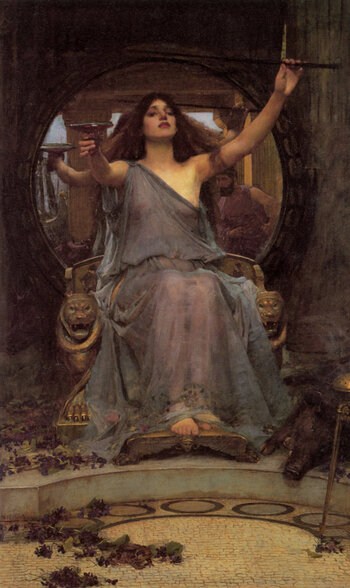
After further disasters — the bag of winds, the cannibals of Laestrygonia, which destroy all but one ship — Odysseus lands on Aeaea, the island of the goddess Circe. He sends twenty-three men to explore. Circe invites them in, serves them food and wine laced with a drug that makes them forget their homes, and turns them into pigs with a stroke of her wand.
Odysseus goes alone to Circe's hall. On the way, Hermes intercepts him and gives him a plant called moly — its black root and white flower make him immune to Circe's magic. When Circe strikes him with her wand, nothing happens. She realizes she has met her match. She frees the men, and invites Odysseus to stay.
He stays for a year.
When his men finally remind him of home, Circe does not try to keep him. Instead she gives him something no one else can: directions. Precise, navigational, dangerous directions — including the instruction that before he goes anywhere, he must first go down to the Land of the Dead and consult the blind prophet Teiresias.
Discussion
- Circe turns men into pigs. What is Homer saying about what happens to men who forget their homes and give themselves to pleasure?
- Odysseus stays with Circe for a year — apparently willingly. Is this consistent with his desperate homesickness on Calypso's island? What's the difference between the two situations?
The Land of the Dead (Book 11)
Odysseus follows Circe's instructions exactly. He sails to the edge of the world, digs a trench, pours libations of honey and milk and wine and water, cuts the throats of two black sheep, and waits. The dead are drawn to blood — it is the only thing that restores them briefly to something like thought.
They come from every direction: brides, young soldiers in bloody armor, girls who died young in love. They make a sound Odysseus describes as thin and terrible, like bats disturbed in a cave.
The Prophecy
'Son of Laertes, Odysseus of the many wiles — I tell you the god will make your journey hard. I do not think you will outwit the Earth-Shaker, who has laid up bitterness in his heart against you for the blinding of his son.
'Yet you may still reach home, though in sorrow, if you can hold yourself and your men under firm rein when you beach your ship on the island of Thrinacia and find there the cattle of Helios who sees and hears everything.
'If you leave those cattle unharmed, you may yet reach Ithaca, though in great hardship. But if you harm them, I tell you plainly your ship will be destroyed, and your men. And even if you yourself escape, you will come home late, in a stranger's ship, having lost every one of your companions, to find trouble waiting in your house.'
Homer gives us the ending of the poem before the poem is half over. Odysseus will make it home. He will find his house full of enemies. He will defeat them. And then — even then — there is one more task before he can rest.
After Teiresias, the dead press forward. Odysseus's mother appears — she died of grief while he was gone. He tries three times to embrace her and three times she slips through his arms like smoke. He speaks with Achilles, who chose a short glorious life and now asks urgently about his son. He glimpses Ajax — who went mad after losing to Odysseus — and Ajax will not look at him. Will not speak. Will not be forgiven.
The silence of Ajax is more terrible than anything else in the underworld.
Discussion
- Homer tells us the ending early. How does knowing the outcome change the way you experience the rest of the story?
- Odysseus cannot embrace his mother's ghost. Homer barely comments on this. Why might he handle such an emotional moment with such restraint?
- Achilles chose a short glorious life over a long quiet one. Now he's a shade underground, and his first question is about his son. What is Homer saying about the choice Achilles made?
- Ajax refuses to speak. In a poem built on the power of speech, what does it mean that the deepest wound Odysseus has caused cannot be answered with words?
The Sirens (Book 12)
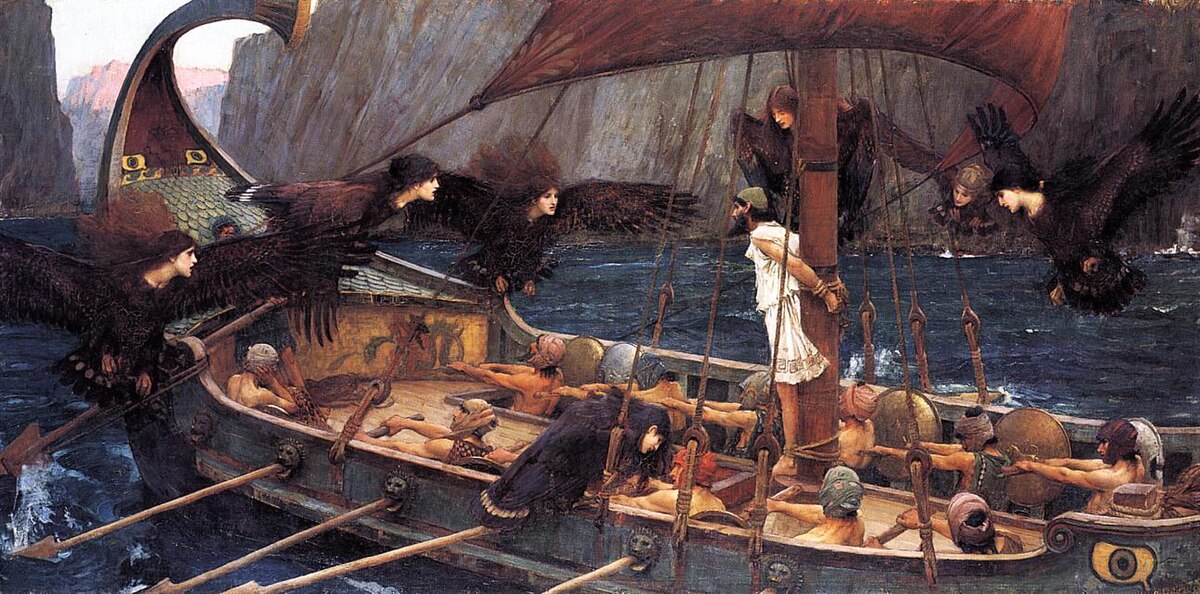
Circe has warned Odysseus about what lies ahead. The Sirens come first — creatures who sit in a meadow ringed with the bones and rotting flesh of men who sailed too close. They sing. Their song is so beautiful that every man who hears it loses all will to survive, to go home, to do anything except hear more.
Circe gives Odysseus a choice: plug his men's ears with wax and sail past, or — and this is remarkable — have himself lashed to the mast and hear the song himself. He can experience the most dangerous thing in the world, if he accepts that he cannot be free while he does.
He chooses to listen. Of course he does.
'Hither, come hither, O much-praised Odysseus — come, great glory of the Achaeans! Beach your ship and listen to our song. No man rows past this point without hearing the honeyed music from our lips. He who listens goes his way delighted and knowing more than when he came. For we know all that the Greeks and Trojans suffered in broad Troy, by the gods' will. We know all that happens on the fertile earth.'
The lovely voice came floating over the water and my heart was seized with longing. I frowned at my men to set me free — but they bent to their oars and rowed the harder. Perimedes and Eurylochus jumped up and bound me tighter.
There is something almost funny about this scene: the greatest hero of the age, reduced to straining against a rope while his sailors ignore his frantic signals and row harder.
But Homer means something serious. The Sirens offer not just beauty but knowledge. They claim to know everything. And they are probably right. The temptation is the possibility of total understanding, if you are willing to stop and listen forever.
Odysseus has chosen not to know everything. He has chosen home.
Discussion
- The Sirens offer knowledge, not just pleasure. Why is knowledge a temptation? What does it say about Odysseus that this is what almost unmakes him?
- Odysseus chooses to be tied up so he can hear the song safely. Can you think of modern examples of people voluntarily limiting their own freedom to protect themselves from their own impulses?
- Homer never gives us the song itself — only the Sirens' introduction. Why might that be exactly the right choice?
Scylla and Charybdis (Book 12)
A narrow strait with a monster on each side. Scylla is a six-headed creature living in a cave above the water, each head on a long neck, each head with three rows of teeth. Charybdis is a whirlpool that swallows the sea three times a day and spits it back.
There is no safe route. Circe's advice is cold and exact: hug the Scylla side and lose six men, rather than risk the whirlpool and lose everything. Do not try to fight Scylla. Row and accept the loss.
Odysseus tells his men about the route. He does not tell them about Scylla. He knows they would freeze. He does, however, put on his armor and take up two spears. He cannot resist the idea of fighting the monster. But Scylla cannot be fought.
While we were taken up with Charybdis, Scylla pounced down suddenly upon us and snatched up my six best men. I was looking at once after both ship and men, and in a moment I saw their hands and feet high above me, struggling in the air as Scylla was carrying them off, and I heard them call out my name in one last despairing cry.
This was the most sickening sight that I saw throughout all my voyages.
He heard them call his name. He watches and cannot help. He says it plainly: this was the worst thing. Not the Cyclops. Not the dead. This.
The Cattle of the Sun (Book 12)
They land on Thrinacia, the island of the sun god Helios, whose sacred cattle graze there. Teiresias has warned. Circe has warned. Odysseus warns his men directly: do not touch the cattle.
They are stranded by storms for a month. The food runs out. Odysseus goes inland to pray, and falls asleep. While he sleeps, the starving men slaughter the best of the cattle. The gods send omens — the hides crawl, the meat bellows on the fire. The men eat anyway.
When the fleet sets sail, a storm rises and destroys the ship with a thunderbolt. Every man drowns. Odysseus alone survives — clinging to the keel, drifting for nine days, until he washes up on Calypso's island.
This is the point where we came in.
The Shape of the Story
Notice how Homer constructs the narrative: Odysseus tells us at the beginning of Book 9 that his men perished through their own sheer folly. Everything in the Adventures section builds toward that moment — the proof that Odysseus was not the one who destroyed his crew. The cattle are the final test, the one they fail. Odysseus survives alone not because he is the strongest but because he is the one who obeyed.